
Breaking: U.S. Launches Unprecedented Strike on Russian Military Targets Amid Escalating Ukraine Crisis
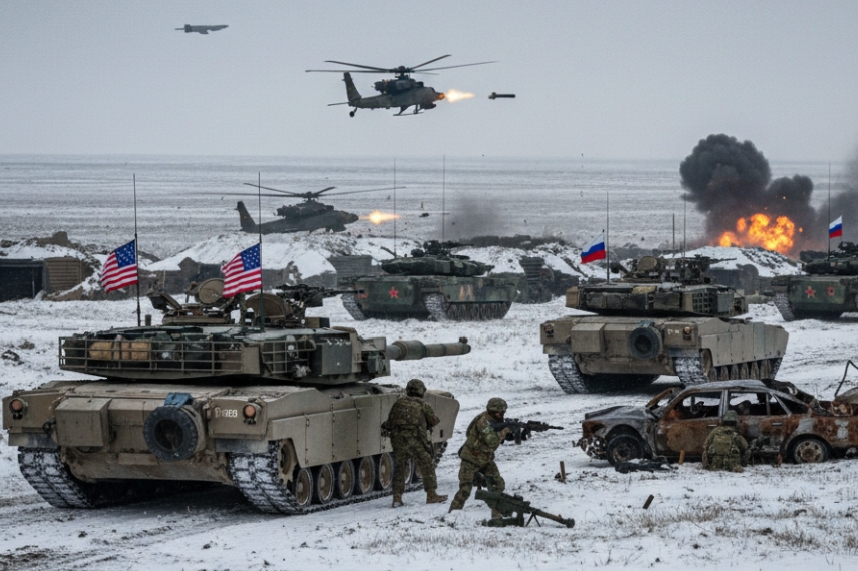
In a dramatic escalation of the ongoing geopolitical standoff, the United States military has initiated a series of precision airstrikes on key Russian installations in the Black Sea region, marking the first direct U.S. assault on Russian soil since the Cold War. The strikes, authorized by President Elena Ramirez in a late-night address from the Oval Office, targeted three strategic airbases and a naval depot near Sevastopol, Crimea, in response to what the White House described as “imminent threats” to NATO allies.
The operation, codenamed “Operation Aurora Dawn,” involved a coordinated fleet of F-35 stealth fighters launching from the USS Gerald R. Ford carrier group stationed in the eastern Mediterranean. Initial reports from the Pentagon confirm that over 50 Tomahawk cruise missiles were fired from submerged Virginia-class submarines, striking radar installations and ammunition storage facilities with pinpoint accuracy. Eyewitness accounts from Ukrainian border regions describe streaks of light illuminating the night sky around 2:00 AM local time, followed by thunderous explosions that rattled windows as far as 100 miles away.
President Ramirez, addressing a stunned nation just hours after the strikes, framed the action as a necessary deterrent against Russian aggression. “For too long, we have watched as Vladimir Putin’s regime sows chaos and death across Europe,” she declared, her voice steady but resolute. “Tonight, we draw a line in the sand. The sovereignty of our allies will not be violated without consequence. This is not war—it is justice.” The president’s words echoed the sentiments of hawkish lawmakers on Capitol Hill, who have long advocated for a more aggressive posture toward Moscow amid the protracted Ukraine conflict, now in its fourth year.
“The Kremlin has crossed every red line imaginable,” Ramirez continued. “From cyber incursions into our power grids to the deployment of hypersonic missiles threatening civilian populations in Kyiv and Odessa. Our patience has run dry.”
Russian state media swiftly condemned the strikes as an “act of naked aggression” by the “fascist NATO cabal.” Foreign Minister Sergei Lavrov appeared on Rossiya-1 television, vowing “retaliatory measures of unprecedented scale.” Unconfirmed reports suggest Russian S-400 air defense systems intercepted at least a dozen incoming missiles, but satellite imagery from commercial provider Maxar Technologies reveals significant damage: craters pockmarking runways at Belbek Air Base, where Su-57 fighters were reportedly housed, and plumes of smoke rising from the Novorossiysk naval yards.
The international community reacted with a mixture of alarm and cautious support. NATO Secretary General Jens Stoltenberg convened an emergency summit in Brussels, issuing a statement affirming “unwavering solidarity” with the U.S. while urging de-escalation. European Union leaders, including German Chancellor Olaf Scholz, expressed “deep concern” over the risk of broader conflict but stopped short of outright condemnation. In Asia, Chinese President Xi Jinping called for an immediate UN Security Council meeting, accusing Washington of “hegemonic overreach” that could destabilize global trade routes.
Behind the scenes, intelligence sources whisper of mounting provocations that tipped the scales. U.S. officials allege that Russian Wagner Group mercenaries, disguised as separatists, sabotaged a Polish pipeline last week, causing a massive oil spill into the Baltic Sea. More alarmingly, intercepted communications purportedly show Moscow authorizing tactical nuclear drills perilously close to NATO borders—a move dismissed by the Kremlin as “routine exercises.”
Military analysts are poring over the implications. “This isn’t just a slap on the wrist,” said retired General Mark Harlan, a Fox News contributor. “Aurora Dawn cripples Russia’s Black Sea projection capabilities for months, if not years. But it opens a Pandora’s box—expect asymmetric responses, from cyberattacks on Wall Street to proxy flare-ups in the Arctic.”
Domestically, the strikes have ignited a firestorm of debate. Progressive Democrats, led by Senator Alexandria Ocasio-Cortez, decried the move as “reckless saber-rattling” that endangers American lives and diverts funds from domestic priorities like climate resilience. Conversely, Republican firebrand Senator Ted Cruz hailed it as “the bold leadership we’ve craved,” predicting a surge in military recruitment.
As dawn breaks over the Atlantic, the world holds its breath. Stock markets in Tokyo and London plummeted in pre-market trading, with Brent crude spiking 15% on fears of disrupted energy supplies. Humanitarian organizations like the Red Cross are mobilizing aid for potential civilian casualties, though both sides claim minimal collateral damage.
What began as a proxy war in the Donbas has now transcended into a direct confrontation between superpowers. Historians draw parallels to the 1962 Cuban Missile Crisis, but with modern arsenals far deadlier. Will this be the spark that ignites World War III, or a calculated feint to force Putin back to the negotiating table? Only time—and the Kremlin’s next move—will tell.
In the hours ahead, expect rolling updates as more details emerge. The White House has scheduled a 10:00 AM briefing, where Defense Secretary Lloyd Austin is slated to unveil declassified footage of the strikes. For now, the message from Washington is clear: America stands ready, but prays foro peace.