
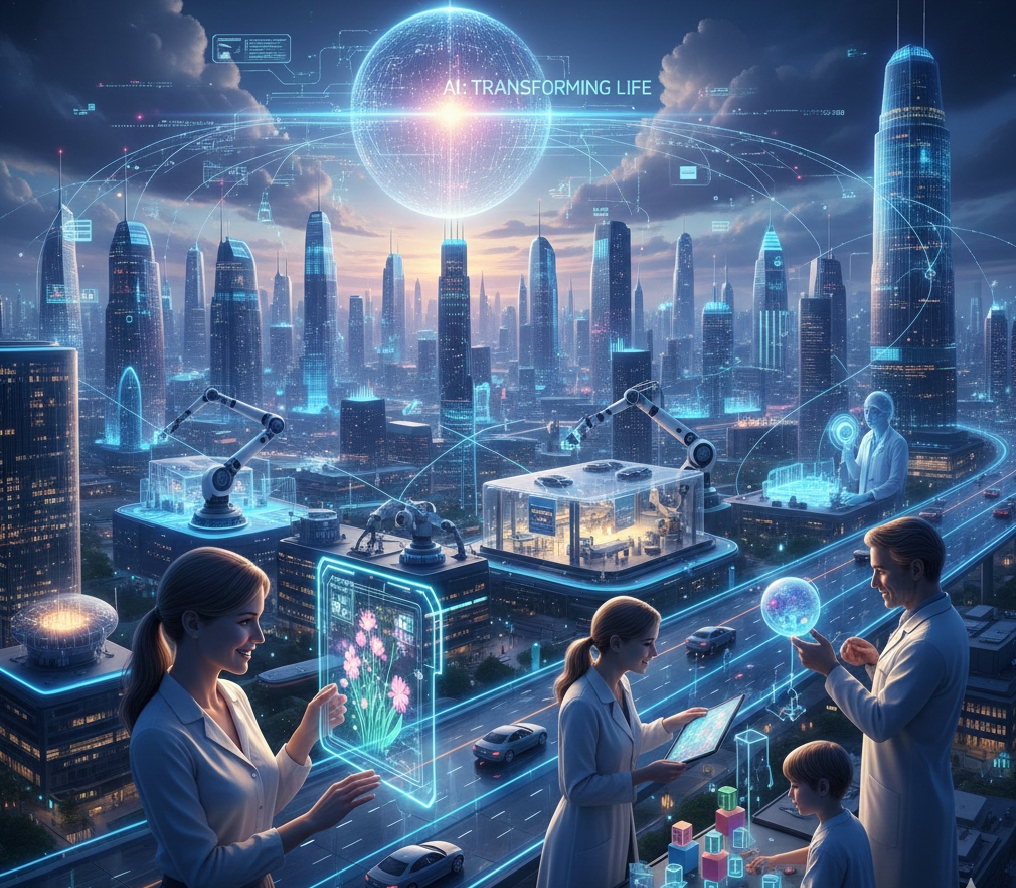
The Future of Artificial Intelligence in Everyday Life
Artificial Intelligence (AI) is no longer a concept limited to science fiction movies or advanced research labs.
Today, AI is deeply integrated into our daily lives, often working silently in the background to make tasks easier,
faster, and more efficient. From smartphones and smart homes to healthcare systems and financial platforms,
AI is reshaping the way humans live, work, and interact with technology.
Understanding Artificial Intelligence
Artificial Intelligence refers to the ability of machines and computer systems to perform tasks that typically
require human intelligence. These tasks include learning from data, recognizing patterns, understanding natural language,
solving problems, and making decisions. AI systems use technologies such as machine learning, deep learning,
neural networks, and natural language processing to continuously improve their performance.
Unlike traditional software that follows fixed rules, AI systems can adapt and evolve based on experience.
This learning capability makes AI extremely powerful and suitable for a wide range of real-world applications.
AI in Daily Life
Most people use AI multiple times a day without even realizing it. Smartphone features like face unlock,
voice assistants such as Siri and Google Assistant, personalized recommendations on YouTube and Netflix,
and navigation apps like Google Maps all rely on AI algorithms.
Social media platforms use AI to decide which posts appear on your feed, while e-commerce websites use it
to suggest products based on your browsing and purchase history. These applications improve user experience
by making digital interactions more relevant and personalized.
AI in Healthcare
One of the most promising areas for AI is healthcare. AI-powered systems are helping doctors diagnose diseases
earlier and more accurately. Machine learning models can analyze medical images such as X-rays, MRIs, and CT scans
to detect conditions like cancer, heart disease, and neurological disorders.
AI is also playing a major role in drug discovery, reducing the time and cost required to develop new medicines.
Wearable devices powered by AI can monitor vital signs in real time, helping patients manage chronic illnesses
and allowing doctors to intervene before conditions become critical.
AI in Education
Education is undergoing a major transformation with the help of Artificial Intelligence. AI-driven learning platforms
can personalize education based on a student’s strengths, weaknesses, and learning pace.
This ensures that no student is left behind and high performers continue to be challenged.
Virtual tutors, automated grading systems, and AI-based content recommendations are making education more accessible
and efficient. In the future, AI may help bridge the gap between quality education and remote or underprivileged areas.
AI in Business and Employment
Businesses across the globe are using AI to optimize operations, reduce costs, and increase productivity.
AI tools are used for customer service through chatbots, demand forecasting, fraud detection,
and data-driven decision-making.
While there are concerns that AI may replace certain jobs, it is also creating new opportunities.
Roles in AI development, data science, cybersecurity, and automation management are rapidly growing.
The future workforce will require reskilling and adaptability to work alongside intelligent machines.
Smart Homes and Smart Cities
AI is transforming homes into smart living spaces. Smart thermostats, lighting systems, security cameras,
and home assistants learn user preferences and adjust automatically to enhance comfort and safety.
On a larger scale, AI is helping build smart cities by optimizing traffic flow, reducing energy consumption,
managing waste, and improving public safety. These innovations contribute to sustainable urban development
and better quality of life.
Ethical Challenges and Risks
Despite its benefits, Artificial Intelligence also presents ethical challenges. Issues such as data privacy,
algorithmic bias, job displacement, and misuse of AI technologies must be addressed carefully.
Responsible AI development requires transparency, fairness, and strong regulatory frameworks.
Governments, companies, and researchers must work together to ensure that AI is used for the benefit of humanity
and not as a tool for exploitation or control.
The Future of AI
The future of Artificial Intelligence holds immense potential. As AI systems become more advanced,
they will collaborate more closely with humans rather than replace them.
AI will act as an intelligent assistant, enhancing human creativity, productivity, and problem-solving abilities.
Emerging technologies such as Artificial General Intelligence (AGI) and human-AI collaboration models
may redefine what machines are capable of achieving. However, ethical considerations and human values
must remain at the core of AI innovation.
Conclusion
Artificial Intelligence is shaping the future of everyday life in profound ways.
From healthcare and education to business and urban development, AI is driving efficiency, innovation, and growth.
While challenges exist, responsible and ethical use of AI can unlock extraordinary opportunities for humanity.
As we move forward, embracing AI with awareness and responsibility will be the key to building a smarter,
more inclusive, and sustainable future for all.