
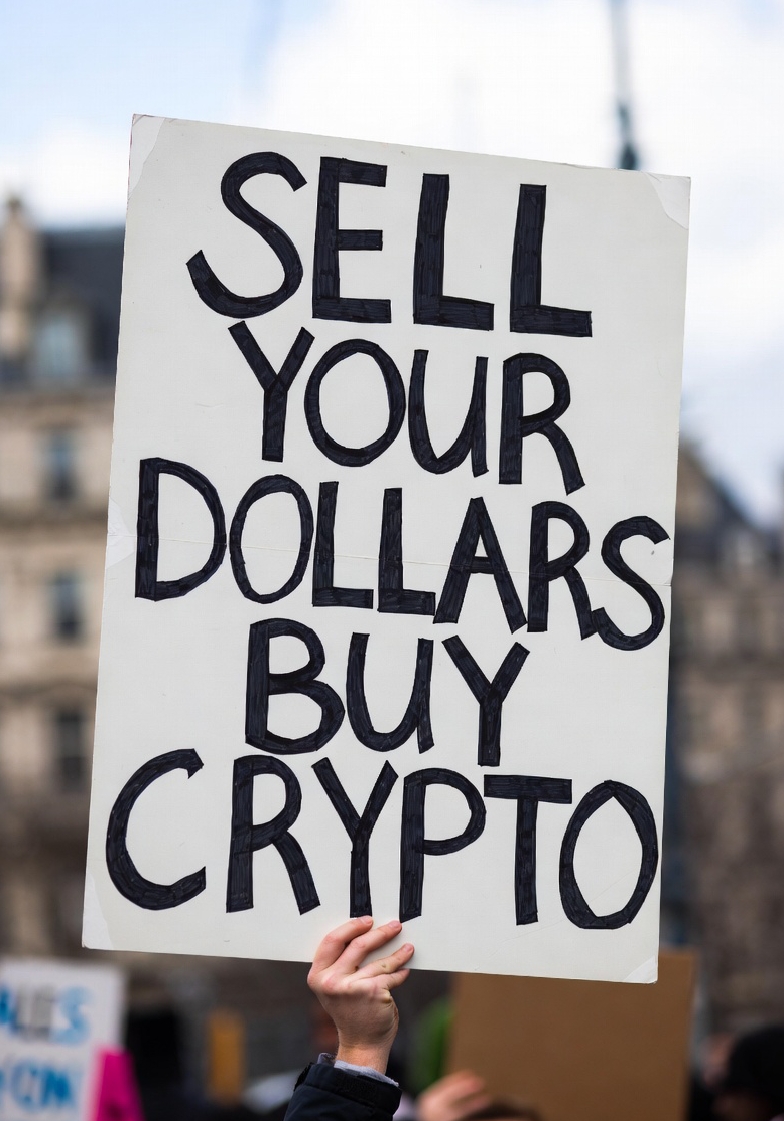
Why I’m Quietly Selling My Dollars and Stocks to Stack Crypto – And Why You Might Want to Do the Same Before It’s Too Late
I never thought I’d be the guy writing this kind of article. Ten years ago I was a boring index-fund investor with a healthy chunk in blue-chip stocks and a savings account that still paid something resembling interest. I mocked my friends who talked about “digital gold” and “magic internet money.” Then 2020 happened, 2021 happened, 2022 crushed everyone, and by late 2025… well, here we are.
I’ve spent the last eighteen months liquidating almost everything that isn’t nailed down in the legacy financial system. Dollars? Slowly bleeding value. Stocks? Priced like it’s 1999 on steroids. Bonds? A joke. Real estate? Illiquid and taxed to death. Meanwhile, the one asset class that actually behaves like it belongs to the internet era keeps proving itself over and over.
This isn’t financial advice I’m not your advisor, and I’m definitely not promising anyone Lambos. This is simply the story of how I reached the conclusion that if I want my family to have real financial sovereignty in the next decade, I have to own keys, not promises.
The Dollar Is Melting in Plain Sight
Let’s start with the obvious. The US dollar has lost more than 24% of its purchasing power since the beginning of 2020 alone. That’s not some conspiracy chart – that’s the government’s own CPI numbers. And that’s the official inflation rate. Anyone who buys groceries, rents an apartment, or fills up a tank knows the real number feels closer to double that.
Every time the Fed prints another trillion (or two, or five), your savings account becomes a slow-motion donation to the Cantillon elite – the banks and institutions closest to the money printer. The further you are from that spigot, the more you get rinsed.
I watched my cash pile shrink in real terms while politicians told me inflation was “transitory.” Then I watched them print another $5 trillion when it clearly wasn’t. At this point, holding large amounts of fiat currency feels like playing musical chairs with a central bank that keeps adding more chairs… right until it yanks them all away.
Stocks Are a 1999 Redux on Steroids
I still love many of the companies I used to own shares in. The problem isn’t the businesses – it’s the valuations and the game being played around them.
Today the “Magnificent Seven” trade at multiples that make the dot-com bubble look rational. The S&P 500’s CAPE ratio is flirting with levels only seen twice before: 1929 and 2000. Both times ended badly. Very badly.
But this time is different, right? This time we have AI! Except… AI is being priced like the internet was in 1998 as if none of the companies will ever have to compete, as if margins will stay 40% forever, as if regulators will stay asleep indefinitely.
I’m not saying the stock market crashes tomorrow. I’m saying when the music stops, the exit doors will be very small and very crowded. And unlike 2000 or 2008, this time the Fed’s balance sheet is already at $8 trillion and rates can’t really go negative much further. They’re out of real ammunition.
The Real Internet Revolution Was Never Social Media
Here’s the part most people still don’t get: we already lived through the first internet revolution. Facebook, Google, Amazon they won the attention and commerce layer. We got cat videos and same-day shipping. Great.
But the money layer of the internet? That revolution is just getting started.
Bitcoin is the base settlement layer. Ethereum and its cousins are the programmable money layer. Solana, Base, and a dozen others are the high-speed consumer layers. Stablecoins are already moving tens of billions per day with no weekends, no holidays, and no permission required.
This isn’t “ speculation.” This is the biggest transfer of monetary power since the abandonment of the gold standard in 1971. Except this time it’s not going from citizens to governments – it’s going from governments and banks to individuals.
“Give me control of a nation’s money and I care not who makes its laws.” Mayer Amschild Rothschild supposedly said that 200 years ago. Satoshi Nakamoto just made it obsolete.
Why Now Feels Different Than 2017 or 2021
I lived through both of those cycles. I bought the top in 2017, sold the bottom in 2018, bought back in 2020, and almost sold the top again in 2021 before deciding to zoom out.
The difference this time isn’t just ETFs or nation-states buying (though both matter). The difference is adoption curves hitting escape velocity:
- BlackRock, Fidelity, and Ark are now the largest holders of Bitcoin on Earth – bigger than MicroStrategy, bigger than most countries.
- PayPal, Cash App, Strike, and now even Walmart are letting normal people buy crypto with zero friction.
- El Salvador made Bitcoin legal tender and their economy is growing faster than almost anyone predicted.
- Stablecoin supply just crossed $200 billion and keeps compounding at 50%+ per year.
- DeFi yield still beats any savings account on the planet – without locking your money up for 30 years.
This isn’t retail FOMO anymore. This is institutions racing to front-run each other while pretending they’re being “prudent.”
My Personal Exit Plan (And Why It Might Work for You Too)
I didn’t go from 0 to 100 overnight. I started with 5% of my net worth in 2020. Then 15% in 2021. By 2023 it was 40%. Today, after selling another batch of Apple and Nvidia shares last month, I’m sitting at roughly 85% in crypto – mostly Bitcoin, some Ethereum, a basket of layer-1s, and a growing pile of stablecoins earning real yield.
The remaining 15% is a mix of physical gold, a paid-off house, and a tiny bit of cash for emergencies. Everything else is gone.
People keep asking me: “What if you’re wrong?” My answer is simple – I’ve already lived through two 80%+ drawdowns. I know exactly what that feels like. The peace of mind that comes from owning an asset no one can freeze, seize, or inflate away is worth more to me than the possibility of being “right” about Tesla hitting another all-time high.
The Digital Life You Want Doesn’t Run on Dollars
Think about the future you actually want in 2035.
Do you want to live in a world where every transaction is tracked, where your bank can deny payments for wrongthink, where your savings lose 7-10% of their value every single year just for existing?
Or do you want the option to pay anyone on Earth in ten seconds for pennies? To earn yield on money that actually keeps up with (or beats) inflation? To move value across borders without begging a government for permission?
That second world already exists. It’s just unevenly distributed – and the window to get positioned is narrower than most people realize.
Final Thought: History Doesn’t Repeat, But It Rhymes
Every major monetary shift in history left a class of people holding the old system while a new one emerged. In the 1400s it was gold vs. silver. In the 1900s it was gold vs. fiat. Today it’s fiat vs. crypto.
The people who moved early weren’t always the smartest – they were just the ones willing to look stupid for a little while.
I don’t know if Bitcoin hits $500k or $5 million. I don’t know which layer-1 ends up dominating DeFi. What I do know is that owning a scarce, censorship-resistant, global, digital bearer asset feels a lot more like “money” in 2025 than a Federal Reserve note that loses value every year by design.
So yeah, I’m selling dollars. I’m selling stocks. I’m buying keys.
And if in ten years I’m wrong, I’ll still sleep just fine knowing I bet on the open, permissionless future instead of the closed, controlled one.
See you on the other side.