
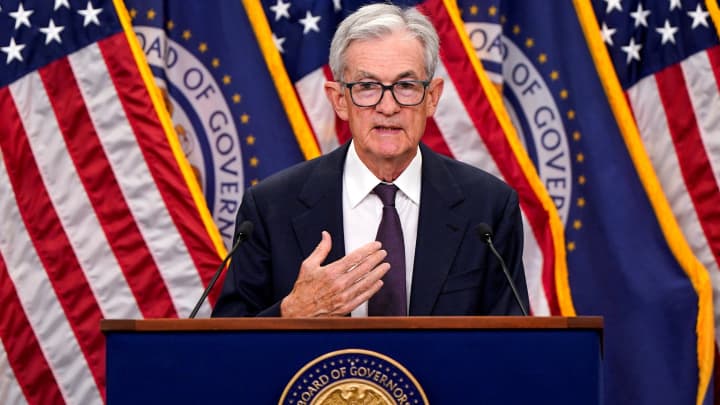
Federal Reserve Chair Jerome Powell told business leaders that the central bank faces a difficult balancing act as it tries to keep prices under control while supporting a job market that is losing momentum. Speaking at a business luncheon in Warwick Rhode Island Powell said there is no risk free path for policy makers as they weigh conflicting economic signals.
Mixed signals in the economy
The economic picture is mixed. Growth has cooled and hiring has slowed yet inflation remains above the Federal Reserve target. Gross domestic product expanded at an annual pace of roughly 1.5 percent in the first half of this year compared with about 2.5 percent last year. For households and business owners the slowdown can feel like less demand for goods and services and smaller gains in revenue. Behind the numbers are stories of families trimming back spending on vacations or home improvements and small businesses hesitating to expand. Such real life effects make the slowing growth more than just an abstract statistic.
Why growth is slowing
Several factors are at work. Higher borrowing costs over recent years have made it more expensive to finance purchases like homes and cars. Businesses have delayed or scaled back investment projects. Weaker global demand has reduced exports. Those forces together have helped slow economic expansion from the faster pace seen last year. For example car dealerships report fewer buyers able to qualify for loans and some manufacturers say orders from abroad have declined. Taken together these forces explain why economic output has cooled.
Labor market cools after a long run
One of the most notable changes is in the labor market. After years of strong hiring the pace has moderated. The unemployment rate rose to 4.3 percent in August while payroll gains averaged just 29,000 jobs per month over the summer. That is a much smaller number than the higher monthly gains that powered the recovery earlier in the decade. Powell described the shift as a marked slowing in both the supply of and demand for workers and called it an unusual and challenging development. For workers this could mean fewer opportunities to change jobs or negotiate higher pay. For employers it may reduce pressure to raise wages but it also signals weaker demand for products and services.
The cooling labor market affects communities in different ways. In fast growing regions fewer job openings may slow population inflows. In areas already struggling with job losses the rise in unemployment may deepen existing problems. The shift also changes how families think about spending saving and planning for the future. People who feel less secure in their jobs often postpone major purchases which can in turn slow economic activity even more.
Inflation is not yet back at target
Inflation remains somewhat elevated compared with the Fed target of two percent. The price index the Fed favors rose 2.7 percent over the year ending in August while the core measure which excludes food and energy climbed to 2.9 percent. Powell said a sizable portion of the recent rise in prices stems from higher tariffs which raise the cost of imported goods. He expects many of those tariff related effects to be temporary as price adjustments spread over several quarters. Still families notice when everyday items cost more and that shapes public perceptions of the economy. Even if tariffs are temporary households must adjust to higher bills in the meantime.
The persistence of inflation above target means the central bank must tread carefully. If it cuts rates too quickly price growth could accelerate again. If it keeps rates high too long unemployment could climb further. The challenge is striking the right balance in real time while dealing with uncertainty about how global events and domestic policies will play out.
What the Fed did and why
At its most recent meeting the Federal Open Market Committee lowered the federal funds rate by a quarter point to a range of 4 to 4.25 percent. The move reflected increased downside risks to employment as job gains slowed and the unemployment rate edged up. Powell explained that the decision was intended to balance the risk of allowing inflation to stay too high against the risk of tightening policy for too long and causing unnecessary job losses.
Powell warned that easing too fast could leave the inflation task unfinished while keeping policy too restrictive for too long could soften the labor market more than needed. That is the tightrope the Fed must walk as it adjusts policy in response to incoming economic data. Economists often describe this as threading a needle. It requires reacting quickly enough to protect growth but not so quickly that the progress on inflation is undone. This balancing act has rarely been easy and history shows that mistakes can either reignite inflation or trigger recessions.
No preset course
Powell made clear that policy is not on a preset course. The Fed will monitor new data on inflation jobs and spending and adjust policy as needed. He reiterated the Fed commitment to support maximum employment and to bring inflation sustainably back to two percent. For many observers that means further policy moves depend on whether inflation falls toward target and whether job market weakness persists or strengthens. In practice this means investors businesses and consumers all watch key data releases closely since they can shift expectations for the Fed’s next move.
What to watch next
The path ahead will be driven by fresh data. Key reports to watch include monthly job numbers inflation measures and consumer spending. Each new report will influence how likely further rate cuts are or whether the Fed will pause to see how earlier moves are affecting the economy. Powell described the process as cautious and data dependent which leaves room for adjustments in either direction. Analysts expect that if unemployment rises further the Fed may respond with additional cuts but if inflation remains sticky policymakers could hold rates steady.
For now households and business leaders face uncertainty but also a measure of clarity. The Fed has signaled it stands ready to respond to weakening labor market conditions while remaining attentive to inflation. That means decisions by the central bank will depend on developments in the months to come. In the meantime families businesses and investors alike will need to stay alert to changes in the data and the Fed’s responses.
For more context and related coverage visit Infinityxverse.