
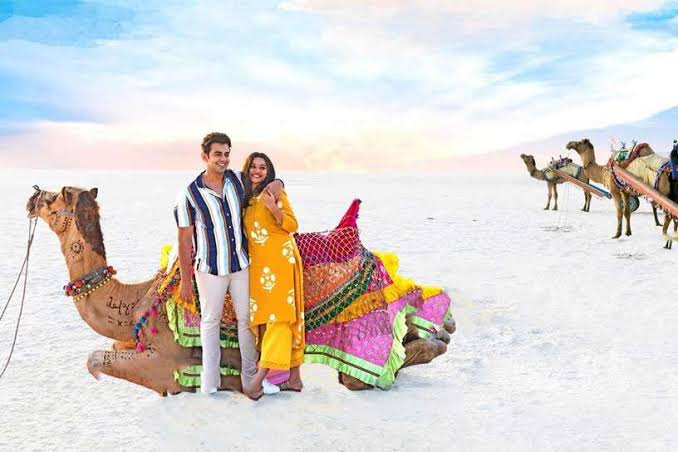
The Rann Utsav – Where the White Desert Comes Alive Every Winter
If you’ve ever stood on a vast expanse of cracked white earth under a sky so clear it feels like someone turned up the contrast on reality, you’ll understand why thousands keep returning to the Great Rann of Kutch in Gujarat.
Every year, as winter settles in, the otherwise barren salt flats transform into something almost magical during the Rann Utsav — a festival that feels part cultural celebration, part surreal dream.
This year (2026), the festival runs from late November through most of March, but February remains the sweet spot. Daytime highs hover around 25–28 °C, nights are still chilly enough to need a shawl, and full-moon nights turn the white desert into a glowing mirror.
My Visit – February 2026
I reached Dhordo — the main tent city hub — around sunset last week with two friends. The first thing that hits you is the silence. Not complete silence, of course — bhajans drift from somewhere, a camel grunts occasionally, laughter floats from other groups — but compared to any Indian city, it’s shockingly quiet.
Then the sky catches fire as the sun drops, painting the salt in shades of orange and pink you don’t think are real until you see them.
The Tent City Today
The tent city has grown smarter over the years. Swiss tents now come with proper beds, solar-powered lights, attached bathrooms (a huge upgrade from the early days), and even a few luxury options with private sit-outs. But the soul of the place is still in the simpler setups — rows of white tents glowing under strings of bulbs, families cooking bajra rotla on small chulhas, groups singing folk songs around bonfires.
The Unscripted Magic
What I love most is how unscripted it feels. One evening we wandered into a performance area where a group of Sufi musicians from the Manganiyar community started playing without any announcement. No tickets, no schedule — just raw voice and sarangi cutting through the cold night air. People sat on the ground in concentric circles, some swaying, some just listening with eyes closed.
Moments like that remind you why we chase these experiences.
Deeper into the Rann
The next morning we took a jeep out deeper into the Rann. The closer you get to the edge, the more otherworldly it becomes. No plants, no animals — just endless white stretching to the horizon. Our driver stopped at a point where you could see the perfect 360-degree flatness — nothing but salt and sky.
Someone in our group lay down on the ground and said, “This is what zero gravity must feel like.” We all laughed, but he wasn’t entirely wrong.
The Real India Bits
Of course it’s not all poetry. There are long queues for camel rides, overpriced chai at some stalls, and the occasional group playing loud music from a speaker (which feels almost criminal in that silence). But even those things become part of the charm — little reminders that you’re still in India, after all.
The People & Their Craft
The locals — mostly from the Rabari, Bharwad, and Mutwa communities — add another layer. Their embroidery is breathtaking; heavy mirror work on black and red fabric that catches the sunlight like tiny fires. Many women sell their own handicrafts directly from small stalls. I ended up buying a pair of leather mojris with intricate stitching — not because I needed them, but because the woman who made them told me the story of each pattern while she wrapped them.
Practical Tips If You’re Planning to Go
- Book tents early (especially on full moon nights — they sell out months ahead).
- Carry warm layers — temperature drops sharply after sunset.
- Respect the place: no plastic, no loud music outside designated areas, please don’t litter the Rann.
- Try the local food — khichdi with kadhi, undhiyu if in season, bajra rotla with gud and ghee.
In a world that’s increasingly filtered through screens, the Rann Utsav still manages to feel real — raw, quiet, and strangely humbling. You leave with salt on your shoes, cold air in your lungs, and the memory of a landscape that refuses to be ordinary.
Have you been? Or is it on your list? February might just be the perfect time to find out.