
Introduction
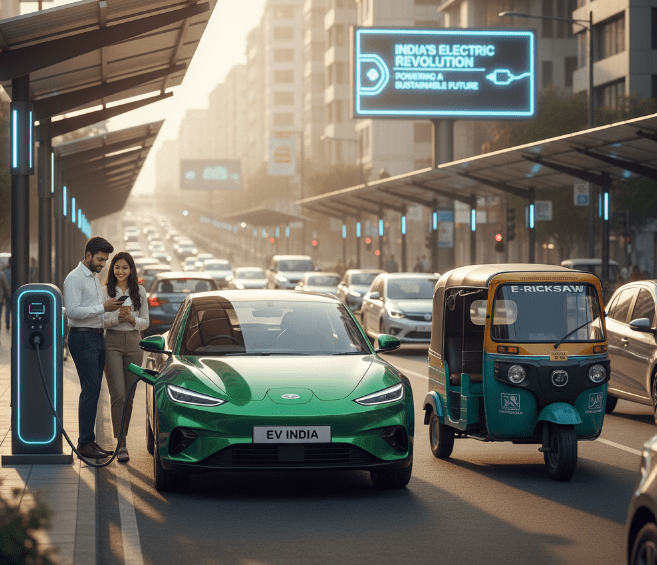
India is standing at the crossroads of a transportation revolution. With rising fuel prices, worsening air pollution, and global climate commitments, the country is slowly but steadily embracing electric vehicles (EVs). While the EV wave started in the West with companies like Tesla, India’s story is unique shaped by affordability, infrastructure challenges, and the aspirations of a young population.
This article dives deep into the current state of EVs in India, the opportunities they create, the obstacles that remain, and what the future might hold.
🌍 Why India Needs Electric Cars
- Air Pollution Crisis – India is home to 14 of the world’s 20 most polluted cities. Switching to EVs could cut emissions drastically, especially in metro areas.
- Rising Fuel Prices – Petrol and diesel prices in India often cross ₹100 per litre in many states. EVs, charged at night, cost far less per kilometre.
- Government Push – Schemes like FAME-II provide subsidies for EV buyers, while state governments are offering tax rebates and free registration.
- Energy Security – India imports over 80% of its crude oil. EV adoption reduces dependence on global oil markets, saving billions in foreign exchange.
⚡ Current Landscape of EVs in India
Here’s how the EV sector looks today:
- Two-wheelers lead the charge: Brands like Ola Electric, Ather Energy, and Hero Electric dominate the EV scooter segment.
- Four-wheelers gaining traction: Tata Motors (Nexon EV, Tiago EV) leads, followed by MG ZS EV and Hyundai Kona.
- Charging infrastructure expanding: Startups and companies like Tata Power are setting up charging stations across highways and cities.
Case Study: Tata Nexon EV became the best-selling electric car in India in 2023, outselling some petrol variants. This shows consumer trust is growing when affordability and practicality align.
🔑 Opportunities in the EV Sector
- Job Creation – Manufacturing, charging stations, and battery recycling could generate millions of jobs.
- Startups & Innovation – Dozens of Indian startups are working on battery swapping, solar charging, and lightweight EV designs.
- Green Investments – Investors see EVs as the next big market. Global automakers want to set up production in India.
- Export Potential – With skilled labour and a large market, India could become an EV export hub for Asia and Africa.
🚧 Challenges Holding Back EV Adoption
- High Initial Cost – Even after subsidies, EVs are more expensive upfront than petrol cars.
- Charging Infrastructure Gaps – Smaller towns still lack charging facilities, causing range anxiety.
- Battery Supply Chain – India relies heavily on China for lithium-ion batteries. Local manufacturing is needed.
- Consumer Awareness – Many people still fear EVs are “too new” or “unreliable.”
🛣️ Government & Industry Initiatives
- FAME-II Scheme – ₹10,000 crore allocated to support EV adoption through incentives.
- PLI Scheme for Battery Manufacturing – Encourages local production of advanced chemistry batteries.
- State EV Policies – Delhi, Maharashtra, and Tamil Nadu offer road-tax exemptions, loans, and subsidies.
- Private Investment – Reliance and Ola Electric are building giga-factories for battery production.
🔮 The Future of EVs in India
Looking ahead, we can expect:
- Affordable EVs under ₹10 lakh to accelerate adoption in middle-class households.
- Battery swapping networks making EVs practical for commercial vehicles.
- Solar-powered charging in rural areas bridging infrastructure gaps.
- EV financing models like subscription or leasing to reduce upfront costs.
If India plays its cards right, by 2030, EVs could make up 30–40% of all vehicle sales, transforming mobility and cutting carbon emissions.
✅ Conclusion
The EV revolution in India isn’t a question of if, but when. While challenges like cost, infrastructure, and consumer trust remain, the momentum is undeniable. With government support, private innovation, and consumer demand, India has the chance not only to adopt EVs but to lead in affordable, scalable solutions for the world.
Electric cars are more than just vehicles they’re a statement of India’s ambition for a cleaner, greener, and more self-reliant future.