
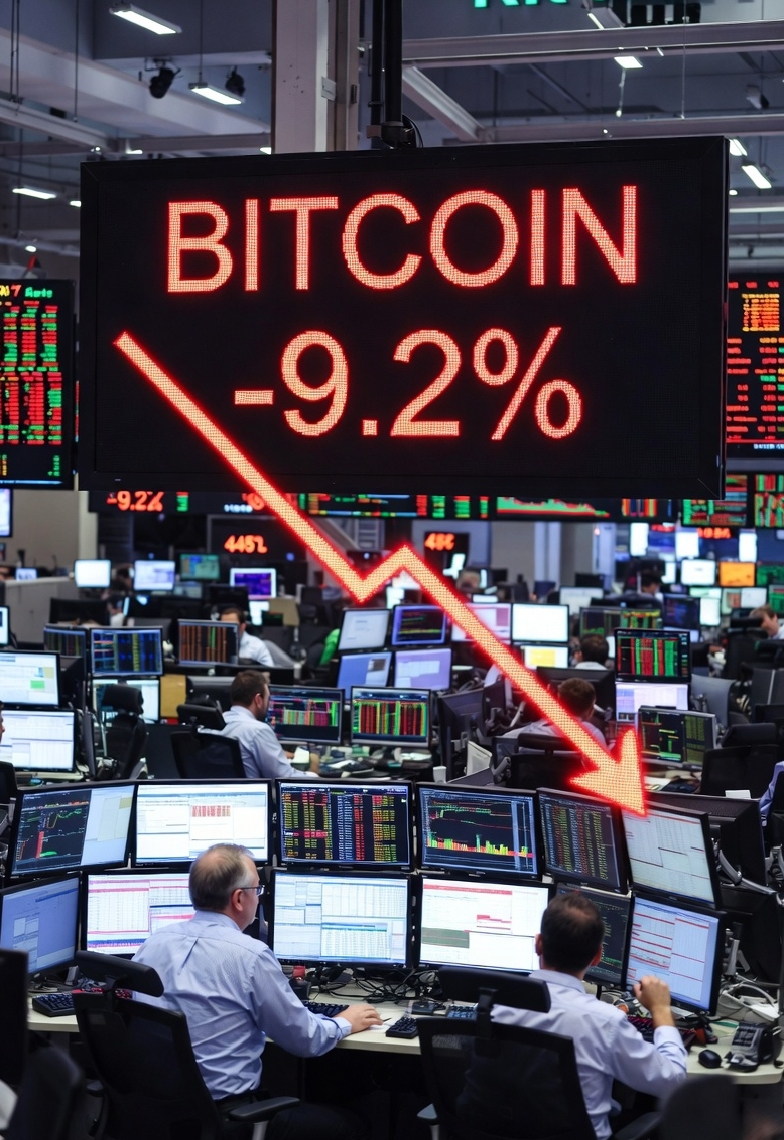
InfinityXverse Analysis: Bitcoin’s $100K Breakdown and What Comes Next
Bitcoin (BTC), the digital economy’s anchor asset, slipped below the symbolic $100,000 threshold —
a level it had fiercely defended for months. Within hours, nearly $1.3 billion in leveraged crypto positions were
liquidated, sending shockwaves through both centralized exchanges and decentralized finance platforms.To the casual observer, it might seem like just another volatile day in crypto. But for market veterans, this move carried deeper meaning:
a signal that macroeconomics, market structure, and trader psychology had all converged in a rare alignment that tested the very fabric of digital asset confidence.

The Event: Bitcoin Breaches a Psychological Barrier
For the first time since mid-2025, Bitcoin’s price fell under six figures momentarily touching $98,400 before recovering slightly.
This marked a 7% single-day drop and an over 10% decline week-to-week.
The speed of the fall reflected not just selling pressure, but algorithmic cascades as automated liquidation systems kicked in once key support levels gave way.
According to Decrypt,
Bitcoin alone accounted for about $470 million in liquidations. On-chain data from Glassnode suggested heavy outflows from whale wallets,
indicating large holders were actively reducing exposure either taking profits or hedging against further downside.
What Drove the Downturn?
1. The Federal Reserve’s Hawkish Surprise
The U.S. Federal Reserve recently disrupted expectations by hinting that rate cuts l once thought inevitable by December might be delayed into 2026.
This stance jolted global markets. Yields spiked, liquidity tightened, and risk appetite evaporated.
As Bitcoin remains highly correlated with broader risk assets, the ripple effect was immediate.
In essence, Bitcoin’s drop was less about crypto itself and more about the changing cost of money.
When borrowing costs stay high, speculative capital tends to exit the highest-volatility corners of finance — and crypto remains at that frontier.
2. Whale Activity and Long-Term Holder Unloading
A deeper layer of the story lies in blockchain behavior.
Bloomberg reported that
long-term holders had sold over 400,000 BTC in the past 30 days equivalent to roughly $45 billion.
Many of these “whale” wallets date back years, suggesting strategic repositioning rather than panic.
This wave of realized profits added supply pressure to an already fragile market. With liquidity pools thinner than usual,
even modest sell volumes had amplified impact, causing price slides across spot and derivative platforms.
3. Technical Triggers and Automated Selling
Bitcoin breached its 200-day moving average a crucial line that many institutional models use to gauge trend momentum.
Once price crossed below it, a cascade of algorithmic selling began.
Quant-driven funds and momentum traders quickly joined the wave, deepening the decline.
Analysts at
The Economic Times projected that if $100K fails to hold as structural support, Bitcoin could test the $88K–$90K region before bottoming out.
4. Sentiment Collapse: From Greed to Extreme Fear
Less than a month ago, crypto sentiment indices reflected “Extreme Greed.”
By early November, they had plunged into “Extreme Fear.” The shift was driven by uncertainty, leveraged losses,
and a growing perception that the 2025 bull cycle might have peaked.

Social media chatter mirrored the panic — with some traders calling it a “micro-bear market” while others viewed it as a necessary reset
before the next leg up. In classic crypto fashion, narratives shifted overnight.
Collateral Damage Across the Crypto Landscape
Bitcoin’s decline set off a domino effect. Ethereum (ETH) lost around 8%, Solana (SOL) fell by nearly 10%,
and both XRP and Cardano (ADA) dropped over 6%.
The total crypto market capitalization slipped below $3.8 trillion.
Meanwhile, publicly listed mining companies like Hut 8 and Marathon Digital saw double-digit losses in stock value
as profitability expectations shrank alongside Bitcoin’s price.
Market Analysis: Levels, Reactions, and Recovery Scenarios
Technically, Bitcoin’s next battleground lies between $100K–$113K.
Regaining momentum above that zone could restore confidence and trigger fresh inflows.
If not, analysts warn of a potential drift toward $88K — a region seen as the next major liquidity pocket.
For now, the asset appears to be consolidating near $101K–$103K, with trading volumes elevated but declining volatility — a classic “cooling-off” phase
after heavy liquidation events. Institutional desks are reportedly reducing leverage, while retail traders shift toward stablecoins and lower-risk DeFi yields.
Investor Psychology and Market Maturity
What distinguishes this correction from previous cycles is the maturity of participants.
Instead of widespread capitulation, much of the current discourse focuses on macro alignment and liquidity strategy.
Veteran investors recognize that volatility is not a flaw in crypto — it’s a feature that filters conviction from speculation.
As one analyst put it on X (formerly Twitter): “Bitcoin doesn’t crash. It recalibrates.”
The InfinityXverse interpretation aligns with that philosophy — price turbulence often precedes innovation and new capital rotations within Web3 ecosystems.
Looking Ahead: Key Variables for 2026
Whether this drawdown turns into a prolonged bear phase or a temporary correction depends on three macro variables:
- Monetary Policy: A dovish Fed pivot could reignite risk appetite across digital assets.
- Liquidity Conditions: Rising global money supply or easing credit could push capital back toward crypto.
- On-Chain Demand: Continued institutional adoption and Bitcoin ETF inflows may offset short-term price pressure.
The consensus among top strategists? Bitcoin remains structurally strong, but the era of “easy gains” has passed.
Future upside will likely be slower, steadier, and driven more by fundamentals than by hype cycles.
Conclusion: A Stress Test for Digital Conviction
The November 2025 crash was not the end of the story — it was a stress test.
For the first time in years, Bitcoin’s narrative collided head-on with macroeconomic reality,
forcing traders, miners, and long-term believers to reevaluate what “value” means in a decentralized age.
InfinityXverse’s view: Bitcoin is entering a new maturity arc. The asset’s resilience at or above the $100K zone will define
not just its near-term price trajectory, but also investor psychology heading into 2026.
Whether it rebounds or consolidates, the lesson remains the same volatility is the toll you pay for exponential innovation.
Your point of view caught my eye and was very interesting. Thanks. I have a question for you. https://accounts.binance.com/el/register?ref=DB40ITMB